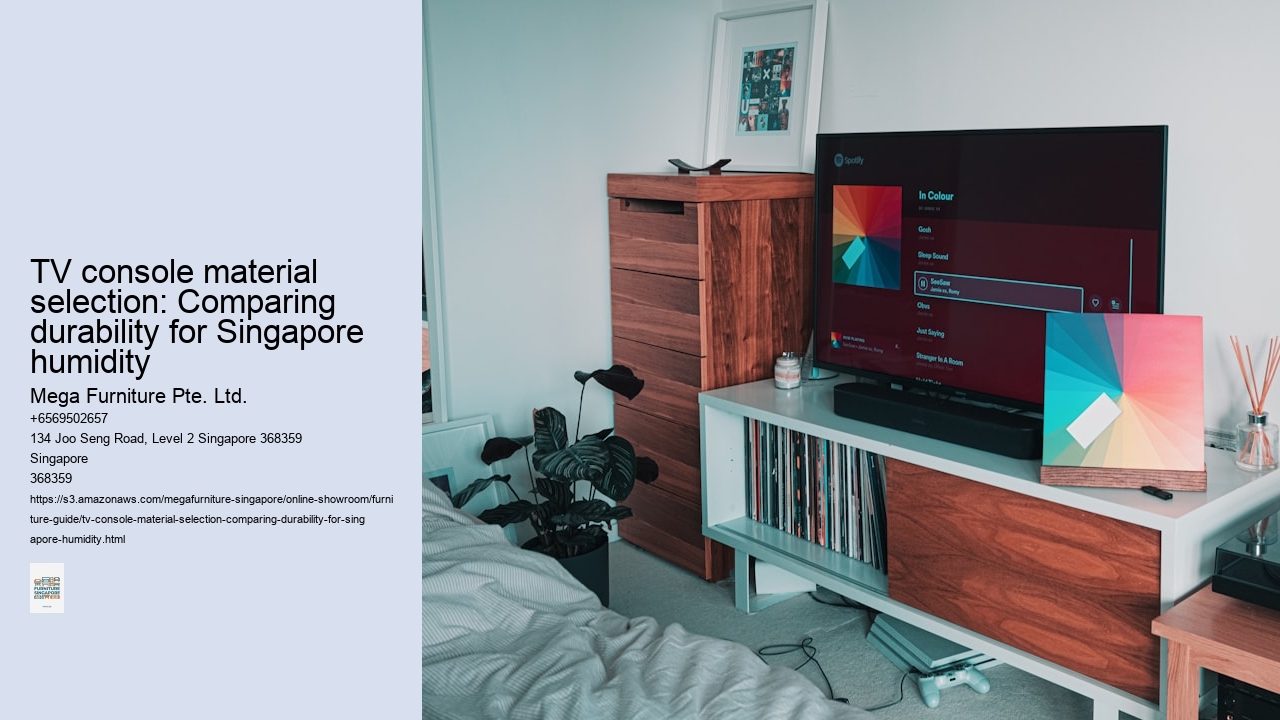
Singapore's humidity will find the weak spot in any piece of furniture—that’s not a prediction, it’s a guarantee. For a TV console, that means prioritising materials that won’t swell or warp in 80% humidity, which rules out most solid wood unless you’re running a dehumidifier constantly. Engineered wood, laminates, and sintered stone composites typically handle the climate better, their layers bonded under pressure to resist moisture ingress. A console that buckles after one monsoon season isn’t just an eyesore; it can throw off your TV’s alignment and stress the cabinet’s joints.
Depth is a practical obsession here. You’ll need around 40 to 45 centimetres, minimum, to comfortably house a media player, a soundbar, and perhaps a router tucked behind it—all while allowing cables some breathing room to prevent overheating. That extra few centimetres over a shallower design makes the difference between a tidy setup and a perpetually tangled mess spilling onto your living room floor. In many four-room BTO layouts, where the console sits opposite the sofa, every centimetre forward also eats into precious walking space.
Then there’s the journey from the lift lobby to your front door. Corridors in older HDB blocks and some condos can narrow to under 90 centimetres, especially near service ducts or electrical risers. A console with sharp, protruding corners becomes a hazard, risking scrapes on walls, your door frame, and your shins. Rounded or chamfered edges aren’t just a design preference; they’re a necessary concession to reality for getting the thing into your flat without leaving a trail of damage.
Finally, consider the surface you’ll be wiping down twice a week. Between construction dust from the next block over and the general grime that settles in high-rise units, a matte or lightly textured finish hides fingerprints and fine scratches far better than a high-gloss lacquer. That frequent wiping, often with a damp cloth, demands a tough, non-porous top; a finish that degrades or stains with moisture defeats the entire point of choosing a resilient material in the first place.
That sleek, affordable console from an overseas online store might not meet SCDF standards — many imported units use laminate or wood veneer with untreated cores that don't comply with local fire-retardant requirements. It's a common oversight for buyers focused on price and style, but the safety certification is non-negotiable for HDB corridors and lift lobbies. You'll want to verify the supplier's technical data sheet explicitly states compliance with Singapore's fire code, not just a generic international standard. A proper certificate from the supplier is your best defence; don't rely on a salesperson's verbal assurance. Without it, you're introducing a significant, and entirely avoidable, risk into your 4-room BTO living room.
Engineered wood with a proper fire-retardant coating typically resists ignition far better than untreated MDF or particleboard, which can smoulder and release toxic fumes. Solid timber, while aesthetically pleasing, often requires specific treatments to achieve the same safety rating as purpose-built engineered panels. The core material matters as much as the surface; a beautiful oak veneer glued onto a substandard base won't protect your family. For peace of mind, prioritise the product's construction specification over its final appearance during your initial research phase.
Integrated lighting and hidden cable management are fantastic for a clean look, but they introduce a major hazard if the wiring runs against combustible backing materials. That LED strip glowing beneath your floating console needs proper insulation and should be routed through channels that won't melt or catch fire. Always ensure any internal wiring is professionally installed and uses sheathing rated for in-furniture use, not standard household extension cords tucked away out of sight. The backing board behind your media wall, where all cables converge, should be a non-combustible panel, not just any spare piece of plywood.
A fire-retardant coating isn't just a clear varnish; it's a chemical treatment that alters how the material reacts to heat, slowing ignition and reducing flame spread. These coatings are often applied at the factory under controlled conditions, which is why retrofitting an existing piece rarely achieves the same level of protection. For laminate finishes, the treatment is usually infused into the resin layer during manufacturing, making it a integral part of the product. It's a feature you can't see, but its absence becomes catastrophically obvious in an emergency.
Don't just ask if it's "fire-safe"; request the specific test report number, usually referencing SS 141 or an equivalent standard accepted by SCDF. Reputable retailers should have this documentation readily available for their stocked items, especially for larger pieces destined for HDB flats. If you're commissioning a custom built-in media wall, the responsibility shifts to your contractor to use compliant materials and provide the paperwork. It's a dry, bureaucratic step, but skipping it means you're betting your family's safety on an assumption — and that's a terrible design choice.
The most expensive TV console is the one that doesn't fit your AVR. Buyers drawn to minimalist, Scandinavian-inspired designs often commit to a sleek profile only to discover their Denon or Yamaha receiver juts out the back by several centimetres, forcing doors to stay perpetually ajar. That clean look is instantly ruined by a tangle of visible cables and a unit that can't actually close. It's a classic case of prioritising Pinterest aesthetics over the physical reality of your components; always measure the depth of your bulkiest piece of audio-visual gear first, then add at least five centimetres for cable management.
Another frequent miscalculation involves assuming any wall is a load-bearing wall. In many older resale flats around Toa Payoh or Queenstown, living room partitions are non-structural drywall, not solid concrete. A floor-standing console is a safe bet, but that elegant floating design you've pinned requires serious anchorage. Attempting to mount a 200cm solid wood console on such a surface risks a catastrophic failure — it's not just about the wall plugs, but the core material they're gripping. If you're unsure, a contractor's assessment is cheaper than a new television and a repaired floor.
Then there's the issue of heat, a silent killer of electronics in our climate. Enclosing a PlayStation 5, set-top box, and router within a cabinet with only a token rear cut-out is asking for trouble, especially in a non-air-conditioned living room. You'll notice the fan noise first, a constant high whir that signals components are throttling. Over time, this sustained heat accelerates wear, shortening the lifespan of equipment that cost far more than the console itself. The solution isn't complex: insist on designs with open shelving for hot items, or incorporate a dedicated ventilation grille at the back.
These oversights often stem from viewing the console in isolation, as a mere styling prop. In a typical 4-room BTO layout, it's the functional backbone of the entire entertainment zone, needing to reconcile technical requirements with daily living. Getting it wrong means living with a nagging, expensive problem for years. Getting it right means you'll forget it's even there — which, for a piece of furniture, is the highest compliment.
A console that’s just a hollow box with doors will betray itself in the first year — the drawer sticks, the side panel bows, and the laminate starts to peel at the corners. That’s why you need to look past the finish and assess the bones. Start with the carcass: solid wood framing around the perimeter, especially at the corners and load-bearing shelves, provides a rigidity that chipboard or MDF alone can’t match; run your hand along the inside of a cabinet opening to feel for a real timber frame, not just the raw edge of a particle board panel.
Drawer operation is another clear signal. Full-extension, soft-close runners are now standard for good reason, but you should test them under load. A quality runner will glide smoothly even with a few hardcover books or a stack of Blu-rays inside — if it sags or grinds, it’s a sign of thin-gauge metal and poor bearings. In a household where consoles double as toy storage or hold gaming consoles, that daily action adds up; a drawer that fails is a major nuisance.
Pay close attention to the edges. Moisture-resistant PVC edge banding, properly applied with heat and pressure, should be seamless and flush to the touch. Any lifting or bubbling, particularly along the top surface where dust accumulates, indicates poor adhesion and invites humidity to seep into the core material — a real concern in our climate. It’s a small detail that speaks volumes about factory quality control.
Finally, don’t underestimate weight. A well-constructed 180cm console in solid rubberwood or with a thick plywood core will have a substantial heft to it, signalling material density and robust joinery. A similarly sized unit that’s suspiciously light often relies on honeycomb paper fillers or very thin panels, which won’t withstand the lateral stress of being moved during spring cleaning or support a 65-inch TV safely. Heft it at the showroom; a good console feels anchored, not precarious.
For those prioritising this kind of built-to-last construction, it's worth visiting a showroom to assess these details in person — you can browse the options at Megafurniture’s Tampines or Joo Seng locations to compare heft and drawer action side-by-side.
The difference between a glossy online photo and the actual finish of a TV console under Singapore’s afternoon glare can be stark — enough to make you rethink your entire living room palette. Online shopping is convenient, but for a piece that anchors your media wall, physical assessment is non-negotiable. You need to see if that walnut veneer looks warm and rich or flat and orange in your specific light; you need to test the drawer glide on a 180cm console to ensure it’s silent and smooth, not wobbly and cheap. A showroom visit lets you do that. At a Megafurniture showroom, you can gauge spatial fit for your specific HDB layout in a way a floor plan never can. A console that looks proportionate online can overwhelm a narrow 4-room BTO living room, or appear lost against a condominium feature wall. It’s about more than measurements — it’s about presence, about how the piece interacts with your walking path from the main door to the kitchen, and whether its height aligns properly with your 55-inch wall-mounted screen. Material finishes demand hands-on inspection. Run your hand over the sintered stone top to feel its texture, check the seams on a laminate wrap, and inspect the joinery on solid rubberwood frames. You’ll understand the practical difference between a high-pressure laminate that feels cool and smooth and a wood veneer with its subtle grain. This tactile confirmation prevents the disappointment of a unit that arrives feeling less substantial than its digital portrayal promised. Logistical complexities, especially for high-floor HDB units without service lifts, become concrete discussions with showroom staff. They can clarify the delivery process for a bulky 220cm console — how it’ll be manoeuvred up the stairwell, what protective measures are taken, and whether assembly is done room-side. This practical intelligence is often glossed over online but is critical for a stress-free installation in neighbourhoods like Bedok or Tampines. Ultimately, committing to a large furniture item sight-unseen is a risk. The showroom visit converts abstract specifications into lived experience, letting you confirm colour, scale, and quality before you commit. It’s the simplest way to ensure your new console fits not just your space, but your expectations. You can start that assessment by browsing the
TV console collectiononline, then plan a trip to see the pieces in person.
The 240cm console you’ve picked might not fit through your HDB’s front door—or down the corridor. That’s the first, often overlooked, delivery hurdle. Always confirm the item’s packaged dimensions and your lift’s landing clearance before ordering; some larger units arrive flat-packed and require on-site assembly in your living room, which means navigating bulky panels through narrow common corridors in estates like Bedok or Tampines. Professional delivery teams are used to this, but you’ll want to be home to supervise.
Assembly itself splits into two distinct jobs. For wall-mounted or floating consoles, proper installation is critical. If your living room wall is brick, as in many older resale flats, installers will use specific masonry anchors. For newer BTO partitions of plasterboard, they’ll need hollow-wall anchors or a toggle bolt system to bear the weight of both the console and your television. A generic screw into drywall won’t hold for long, and a poorly secured unit is a genuine safety risk in a family space.
The warranty terms matter just as much as the installation. Look beyond a simple guarantee against manufacturing defects. Given Singapore’s constant humidity, you need coverage for long-term structural integrity—warping or joint failure—and surface defects like veneer peeling or laminate blistering. A one-year warranty is standard, but two years offers better peace of mind for a substantial piece that endures daily use and our climate. That humidity spares nothing, not even engineered wood.
Consider professional installation a worthwhile investment for any wall-mounted design. It ensures the unit is securely fixed and level, and it often preserves the warranty; self-assembly errors can void coverage. For a floor-standing model, you might manage with the provided instructions, but that’s a weekend project with a high frustration potential. The goal is a seamless media wall, not a lopsided console and a collection of leftover screws.
Finally, inspect the piece thoroughly upon delivery. Check for transit scratches, colour consistency across panels, and smooth operation of any drawers or doors. Report any issues immediately—don’t wait until the installers have left. A good retailer will resolve this promptly, and documenting it early strengthens your warranty claim. It’s a tedious step, but it beats discovering a chip behind your soundbar six months later.
The most common email query isn't about colour or storage — it's a photo from a homeowner, taken from their sofa, asking if their new 65-inch TV is hung too high. The ideal TV console height anchors the entire viewing experience; centre of screen should align with your seated eye-line, which in a typical Singaporean living room means a console height around 40 to 50cm. That low profile forces a specific kind of storage, often shallow drawers for remotes and game controllers rather than deep cabinets for bulky items.
Cable chaos, especially with StarHub or fibre TV boxes, is the second most frequent complaint. A console with a dedicated media compartment and strategic cable ports at the back is non-negotiable; some buyers even install a simple power strip inside a cabinet, feeding all cords through a single grommeted hole. It’s a small detail that prevents the living room from looking like a server room.
For those in ground-floor units or flats with exposed ledges, material choice goes beyond aesthetics. Laminate or wood veneers can swell at the edges if placed within a metre of a window during relentless monsoon rain, whereas sintered stone or powder-coated metal tops handle the occasional splash without a second thought. Pet owners ask similar questions, steering clear of glossy lacquers that show every claw mark and leaning toward textured wood grains or scratch-resistant laminates that can withstand an excited terrier.
Then comes the built-in versus freestanding debate, which often hinges on your BTO renovation timeline. A custom carpentry media wall looks seamless but locks you into a layout and adds $3,000 to $8,000 to your reno bill; a freestanding console from Megafurniture’s collection can be ordered after you move in, swapped out in five years, and doesn’t count toward your renovation loan. For resale flats with existing built-ins, the calculation flips — you’re often matching a height or filling an awkward niche, which makes modular, configurable units the practical choice.
Before you step into a showroom, your living room floor should be a grid of masking tape and scribbled Post-it notes. That final dry run is where a centimetre’s error translates to a router left dangling off the side or a subwoofer that simply won’t fit. The dimensions you need aren’t just the TV’s screen size—it’s the depth of the AVR with all its cables plugged in, the exact footprint of the subwoofer, and the crucial clearance behind the console for power bricks and ventilation. For a 75-inch TV, you’ll likely need a console at least 180cm long, but the real test is whether your PlayStation, Switch, and media boxes can all be stowed without overheating. List your storage needs like a packing list for a move. How many gaming consoles, set-top boxes, and hard drives need a home? Where does the fibre router go—inside a cabinet, which can kill the signal, or on an open shelf? Prioritise load capacity over a sleek silhouette; a console crammed with gear can easily hold over 50kg, and particleboard shelves will sag over time under that strain. Material safety is non-negotiable, especially in a built-up HDB block—look for solid timber or properly engineered wood with certified low-formaldehyde finishes, not just the cheapest laminate. Then, sync your purchase with the critical path of your life. A delivery date that’s a week after your key collection leaves you sitting on the floor; a date that’s too early during renovation means a dusty console in a construction zone. Confirm lead times explicitly—whether it’s ready stock or a four-week custom order—and buffer for the inevitable rescheduling. That logistical alignment is what turns a piece of furniture into a functioning part of your home, not an obstacle in a box. You can
browse the optionsonce your own numbers are definitive.
A 75-inch panel dominating the feature wall of a 4-room BTO living room looks precarious on a 140cm console - it's a common mismatch, and it undermines the entire setup's stability. Display cabinets sit between bookshelf and storage cabinet in function — closed glass-front protection for the items you want visible but not collecting dust. Megafurniture's Storage Cabinet range covers glass-front, curio, wall-mounted, and freestanding configurations in solid wood, MDF, and metal-framed constructions. Average pricing for glass-front variants sits around $271, with LED-lit and motorised-shelf models commanding the higher tier.. A TV console anchors the wall opposite the sofa in the same way a tall bookshelf anchors a corner — long horizontal piece, mix of open and closed storage, defines the visual weight of one whole side of the room. Megafurniture's TV Console range covers floating wall-mounted designs, low-profile freestanding consoles, and modular feature-wall configurations. Most pieces sit at 40-50cm height, sized for screens up to 75 inches.. The rule of thumb is simple: the console's length should at least match the TV's width, which for that 75-inch screen means a minimum of 180 centimetres. Anything shorter risks a top-heavy look and offers no buffer for soundbars or decorative items at the ends; you're essentially building a visual cliffhanger. In many HDB layouts, that 180-240cm span also neatly fills the wall between two bedroom doors, creating a built-in media wall effect without the renovation cost.
Configuration becomes the critical next decision, dictated by your room's square footage and who lives in it. For the typical 12 sqm living room in a compact flat, a floating console is the default choice - it lifts the visual weight off the floor, making the space feel less cluttered and slightly more generous. Floor-standing units, however, offer a solidity that floating designs can't match, and they bring valuable enclosed storage for routers, board games, or pet supplies in homes where every cubic foot counts. The choice often comes down to a trade-off: perceived spaciousness versus actual storage capacity.
Wall-mounted consoles take the floating concept further, eliminating any contact with the floor entirely. This isn't just an aesthetic preference; it's a practical necessity for households with toddlers learning to walk or with pets that shed. A Bookshelf earns its place in Singapore homes through dual function — book and decor storage in the open shelves, soft visual division when placed mid-room in open-plan condominium layouts. Megafurniture's combined display unit and bookshelf hub covers tall book racks, cubby-hole designs, ladder shelves, modular cube systems, and glass-door pieces in oak, walnut, and MDF veneer finishes. Solid-wood pieces typically start around $425, with most heights spanning 120cm to 220cm to fit standard 2.6m HDB ceilings.. A clean sweep underneath with a mop or robot vacuum is possible, and there are no corners for dust or toy cars to collect. The installation demands proper mounting into solid brick or reinforced concrete, a step that rules out some older resale flats with hollow partition walls.
Material choice then follows form. A long, wall-mounted console in a family home needs a tough, wipeable surface - think sintered stone or a high-pressure laminate that can withstand stray crayon marks and coffee cup rings. That 180cm solid wood console might be a beautiful, sturdy anchor, but in a sun-facing room in Tampines, you'll need to consider potential warping over time. The dimensions set the stage, but the material ensures the console lasts through the realities of daily life.
A 75-inch panel dominating the feature wall of a 4-room BTO living room looks precarious on a 140cm console — it’s a common mismatch, and it undermines the entire setup’s stability. The rule of thumb is simple: the console’s length should at least match the TV’s width, which for that 75-inch screen means a minimum of 180 centimetres. Anything shorter risks a top-heavy look and offers no buffer for soundbars or decorative items at the ends; you’re essentially building a visual cliffhanger. In many HDB layouts, that 180-240cm span also neatly fills the wall between two bedroom doors, creating a built-in media wall effect without the renovation cost.
Configuration becomes the critical next decision, dictated by your room’s square footage and who lives in it. For the typical 12 sqm living room in a compact flat, a floating console is the default choice — it lifts the visual weight off the floor, making the space feel less cluttered and slightly more generous. Floor-standing units, however, offer a solidity that floating designs can’t match, and they bring valuable enclosed storage for routers, board games, or pet supplies in homes where every cubic foot counts. The choice often comes down to a trade-off: perceived spaciousness versus actual storage capacity.
Wall-mounted consoles take the floating concept further, eliminating any contact with the floor entirely. This isn’t just an aesthetic preference; it’s a practical necessity for households with toddlers learning to walk or with pets that shed. A clean sweep underneath with a mop or robot vacuum is possible, and there are no corners for dust or toy cars to collect. The installation demands proper mounting into solid brick or reinforced concrete, a step that rules out some older resale flats with hollow partition walls.
Material choice then follows form. A long, wall-mounted console in a family home needs a tough, wipeable surface — think sintered stone or a high-pressure laminate that can withstand stray crayon marks and coffee cup rings. That 180cm solid wood console might be a beautiful, sturdy anchor, but in a sun-facing room in Tampines, you’ll need to consider potential warping over time. The dimensions set the stage, but the material ensures the console lasts through the realities of daily life.